
When a dental claim is paid, three terms tend to show up again and again: EOB, ERA, and EFT. They are related, but they are not interchangeable. Confusing them can slow posting, create reconciliation problems, and make it harder to explain balances to patients.
The cleanest way to think about them is this: the claim form reports the services, the remittance explains the payment, and the funds transfer delivers the money. In a modern billing workflow, each part has its own job.
Dental EOB vs ERA vs EFT at a glance
A fast comparison helps clear up most of the confusion.
| Term | Full name | Main purpose | Format | Who typically uses it most | Key billing impact |
|---|---|---|---|---|---|
| EOB | Explanation of Benefits | Explains how a claim was processed | Often paper or payer-specific document | Patients and front office teams | Helps explain benefit application and patient responsibility |
| ERA | Electronic Remittance Advice | Electronic explanation of claim payment and adjustments | HIPAA standard X12 835 | Billing teams and software systems | Supports automated posting and adjustment handling |
| EFT | Electronic Funds Transfer | Moves the payment into the practice bank account | ACH-based payment transfer | Billing teams, finance staff, bank reconciliation staff | Speeds deposit and supports faster reconciliation |
The biggest operational difference is simple. An EOB or ERA tells you why a payment was made the way it was. EFT gives you the money.
That distinction matters because posting a claim properly requires both payment details and the actual deposit. If a practice gets one without the other, staff often end up chasing documents, rechecking claims, or manually matching deposits to remittances.
What a dental EOB means in day-to-day billing
An EOB is the explanation of benefits statement tied to a processed claim. It commonly shows the services billed, the amount submitted, the amount allowed, the amount paid, and the portion assigned to the patient. Many patients receive an EOB from the payer, and many dental offices review EOB information when answering billing questions.
The American Dental Association points out that the EOB statement and the ERA received at the office are both important for making sure payment is correct. That is an important reminder because practices sometimes treat the EOB as a patient communication tool only. It is that, but it is also a payment explanation document.
In practical use, the EOB is often the item that helps staff explain a remaining balance at the front desk or over the phone. If a patient says, “I thought insurance covered this,” the EOB usually gives the clearest payer-facing explanation of deductibles, frequency limitations, downgrades, alternate benefits, or non-covered services.
A few common reasons teams still rely on EOB review:
- Patient balance questions
- Coordination of benefits review
- Manual follow-up on unusual claim outcomes
- Secondary insurance support
What a dental ERA is in electronic dental billing
An ERA is the electronic version of remittance information. Under HIPAA standards, the ERA is transmitted in the X12 835 format. CMS identifies the 835 Version 5010 as the national standard for electronic remittance advice.
This matters because ERA is built for systems, not just people. Practice management software and billing platforms can use ERA files to post payments and contractual adjustments much faster than a staff member reading a paper document line by line.
That is where ERA becomes a workflow tool instead of just a record. CMS notes that ERA can automatically post line-item and claim payment amounts and adjustments into billing or accounting applications. For a busy dental practice, that means less manual posting, fewer keystroke errors, and quicker claim reconciliation.
ERA records often include standardized codes that explain why something was paid, reduced, or denied. Those may include CARCs and RARCs, which help translate payer action into billing action. If the software and team know how to read those codes, the office can respond faster.
Here is what ERA usually gives a dental billing team that a paper process does not:
- Structured data: Payment, adjustment, and denial information in a standard electronic format
- Posting speed: Faster line-by-line posting into the practice management system
- Better reporting: Cleaner data for A/R review, payer trend analysis, and denial tracking
- Less rework: Fewer manual mistakes caused by keying payment data by hand
What a dental EFT is and why it matters for cash flow
EFT is the actual payment transfer. Instead of waiting for a paper check, the payer sends funds electronically to the provider’s bank account, generally through ACH-based methods. CMS identifies EFT standards separately from ERA standards, even though both are part of the electronic payment ecosystem.
That separation is important. ERA is not the money, and EFT is not the remittance detail. One explains. One pays.
For dental practices, EFT usually means faster access to collected revenue, lower risk of lost checks, and less staff time spent handling paper deposits. It also supports cleaner month-end close work because the payment lands in the bank electronically and can be matched back to remittance data.
The ADA has also indicated that dental offices should not be charged for a dentist to receive a standard EFT payment. That is useful to keep in mind when reviewing payer enrollment options or third-party payment arrangements. Practices should also look carefully at virtual credit card arrangements, since those can carry processing costs that do not apply to standard EFT.
The dental claim form is separate from EOB, ERA, and EFT
A common source of confusion is putting the claim form in the same bucket as payment documents.
It is not.
The ADA Dental Claim Form is the common format for reporting dental services to a patient’s dental benefit plan. It is how the office communicates what treatment was performed, including procedure codes and clinical details like tooth number, tooth surface, or area of the oral cavity when required.
That means the claim form comes first in the billing cycle. EOB, ERA, and EFT all come later, after adjudication.
A simple way to map the process looks like this:
- Submit services on the dental claim form
- Payer processes the claim
- Receive the remittance explanation through EOB, ERA, or both
- Receive payment through check, EFT, or another method
- Post, reconcile, and bill the patient for any remaining balance
How EOB, ERA, and EFT fit into a modern dental billing workflow
In a well-run workflow, these items are not handled as isolated transactions. They are linked pieces of one revenue cycle.
The process starts with accurate claim submission. If CDT coding, tooth numbers, surfaces, dates of service, and subscriber data are wrong, the office may still receive an EOB or ERA, but it may reflect reduced payment, denial, or requests for correction. Clean claims still matter more than anything else upstream.
Once the payer adjudicates the claim, the office needs usable remittance detail. If the practice is set up for ERA, the billing system can usually import payment and adjustment data directly. If the office relies on paper documents only, posting takes longer and often depends on staff interpretation.
After that, the EFT deposit should match the remittance. CMS notes that one check or one EFT may represent all benefits due for the claims itemized in the ERA or standard paper remittance. That means staff cannot assume one payment equals one patient claim. A single deposit may cover many claims.
A healthy workflow usually includes these checkpoints:
- Claim submission: Clean ADA claim form data with correct CDT coding and attachments when needed
- Remittance intake: ERA import or EOB review for payment explanation and adjustment detail
- Deposit verification: Confirm EFT receipt and amount in the bank
- Reconciliation: Match deposit to remittance using trace information
- Patient billing: Transfer accurate residual balances only after insurance posting is confirmed
When those checkpoints are missing, cash posting slows down and A/R gets less reliable very quickly.
Why TRN matching matters for ERA and EFT reconciliation
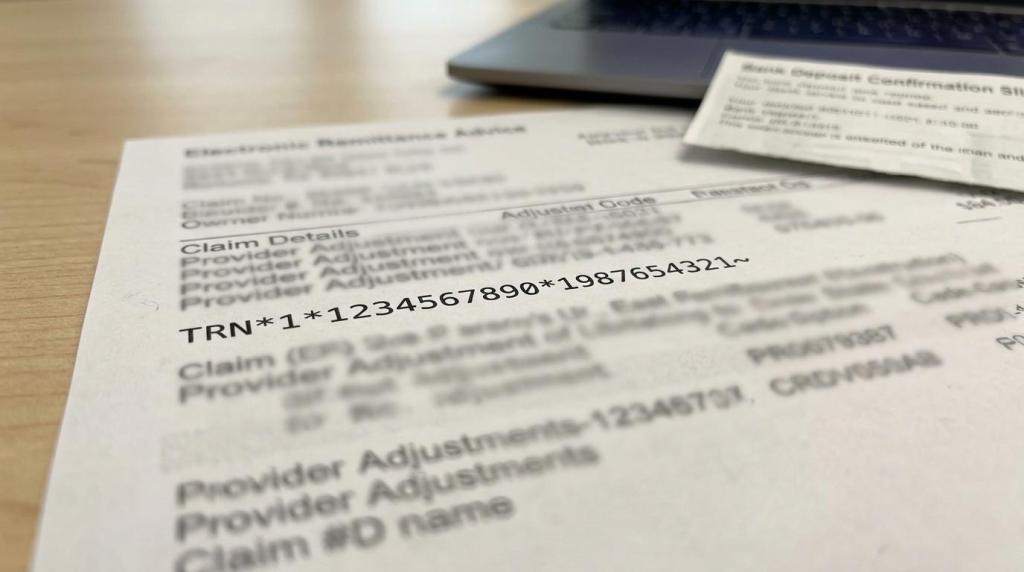
One of the most useful links between ERA and EFT is the TRN, or trace number. CMS ties remittance data to payment reconciliation through the TRN Associated Trace Number, which helps providers match the electronic remittance to the actual payment.
This is a big deal operationally. Many practices know an ERA arrived and know a deposit hit the bank, but they do not have a consistent process for confirming which remittance belongs to which payment. That is where unapplied cash, duplicate posting risk, and “mystery deposits” start to show up.
When the team uses the TRN correctly, reconciliation gets faster and cleaner. The ERA explains what was paid. The EFT confirms the funds were transferred. The TRN helps prove those two records belong together.
If a practice is trying to tighten posting controls, the TRN should be part of the standard payment review process.
Common dental billing issues when EOB, ERA, and EFT are confused
Many payment posting problems are not payer problems at all. They are workflow problems caused by mixing up the roles of these documents.
A few examples show up often in dental offices:
- Posting from an EOB before the EFT deposit is confirmed
- Treating an EFT deposit as fully posted cash without reviewing the ERA
- Assuming a single deposit belongs to one claim or one provider only
- Missing denial or adjustment codes because staff looked only at deposit data
- Sending a patient statement before insurance posting is fully reconciled
Those mistakes can lead to bad patient balances, reworked claims, and unreliable collections reporting. They also create unnecessary phone calls because patients get statements that do not match what their insurer told them.
What to look for in ERA and EFT setup with payers
A modern setup is not just “electronic” on paper. It should reduce work, speed up cash application, and make reporting more reliable.
When reviewing payer setup, enrollment, or billing support processes, practices should look for a few practical items:
- ERA enrollment status: Active, tested, and posting correctly into the practice management system
- EFT enrollment status: Direct deposit confirmed with the correct bank account and payment routing
- TRN visibility: Easy way to match remittance and payment records during reconciliation
- Adjustment mapping: CARC and RARC codes handled correctly in posting workflows
- Payment method review: Standard EFT preferred over paper checks or fee-based virtual card processing
It also helps to know who owns each step. Some problems sit with the payer, some with software configuration, and some with internal posting habits. If no one clearly owns reconciliation, even a fully electronic process can still produce old-fashioned bottlenecks.
When dental practices benefit from outside billing support
Many practices adopt ERA and EFT but still do not get the full time savings they expected. That usually happens when the tools are present, but the workflow around them is inconsistent.
A billing team or outside dental billing partner can be especially helpful when the office is dealing with high claim volume, aging A/R, multiple payer enrollment issues, or a backlog of unapplied insurance payments. The goal is not just electronic intake. The goal is accurate posting, faster follow-up, and dependable cash flow reporting.
Signs that the current setup may need attention include:
- Rising unapplied cash
- Slow insurance posting
- Frequent patient balance disputes
- Delayed secondary claims
- Unclear deposit-to-remittance matching
For practices focused on efficiency, the best model is straightforward: submit clean claims, receive structured remittance data, accept payment by EFT, match records using TRN, and post patient responsibility only after the insurance side is fully reconciled. That is the workflow that turns EOB, ERA, and EFT from confusing abbreviations into useful financial controls.