
A dental no-show charge policy can protect chair time, reduce scheduling waste, and set clearer expectations with patients. It can also create billing disputes, contract issues, and compliance risk if the policy is written loosely or applied unevenly.
For most dental practices, the key point is simple: a missed appointment fee is usually a patient charge, not an insurance claim. That distinction affects how the fee is posted, documented, communicated, and collected. It also affects whether the practice should charge it at all for certain patient groups or payer types.
Why a dental no-show charge policy affects revenue and patient access
Missed appointments are more than a front-desk problem. They reduce provider productivity, leave hygiene time unused, and push treatment further out on the schedule. In a busy office, even a modest no-show rate can affect monthly collections because production opportunities disappear before a claim is ever created.
A policy can help, but only if it fits the reality of the practice. A very strict fee may recover some lost revenue, yet it can also create pushback, bad debt, or negative reviews if patients see it as punitive. Many offices get better results when the fee policy is only one part of a larger scheduling system.
Common effects of repeated no-shows include:
- unused chair time
- lower hygiene production
- delayed treatment acceptance
- extra rescheduling work
- weaker provider schedules
A well-run policy should support attendance without making access harder for patients who face legitimate barriers.
Dental no-show billing and coding rules
Dental teams often ask whether there is a CDT code for a missed appointment. In standard dental coding, the answer is generally no. CDT is used to report procedures actually performed. If the patient did not receive a covered dental service, there is usually no claim-ready dental procedure code for that event.
That means a no-show fee is usually handled as an internal administrative charge. It may be posted to the patient ledger using a local office code or an accounting label in the practice management system, but it is not typically submitted to a dental plan as though treatment occurred.
The clinical record still matters. The dental chart should note the missed visit, the date and time, the appointment type, and any contact made with the patient. From a revenue cycle standpoint, that note supports consistency and helps explain why a ledger charge was added or waived.
| Item | Standard approach in dental practices |
|---|---|
| CDT code for no-show | No standard CDT procedure code |
| Insurance claim submission | Usually not submitted |
| Ledger posting | Internal admin code or patient charge |
| Clinical record | Missed appointment note with date, time, and staff entry |
| Financial responsibility | Based on signed office policy and payer rules |
This is where many offices get into trouble: they treat a no-show fee like billable treatment, or they document it so lightly that staff cannot defend the charge later.
Dental insurance and payer rules for missed appointment fees
Payer rules are not the same across all patients. A no-show fee that seems routine for a self-pay patient may be restricted or barred for a Medicaid patient, and Medicare has its own rules.
CMS guidance is clear that Medicare does not pay for missed appointments. A provider may usually charge a Medicare beneficiary directly for a missed appointment, but the fee cannot be billed to Medicare, and it must be applied on the same basis as it is for non-Medicare patients. In plain terms, a practice should not single out Medicare patients or use a different fee structure for them.
Commercial dental plans are less uniform. Many contracts do not reimburse missed appointment fees because no covered service was delivered. Some participation agreements may also limit what extra charges can be collected from plan members. Medicaid is even more sensitive. State rules, managed care contracts, and access standards may restrict these fees heavily.
| Payer type | Can the practice bill the payer? | Can the practice charge the patient? | Main caution |
|---|---|---|---|
| Self-pay | No payer involved | Usually yes | Follow signed policy and state law |
| Medicare | No | Often yes | Same fee as non-Medicare patients, do not bill Medicare |
| Medicaid | Usually no | Sometimes limited or prohibited | Check state rules and MCO contract |
| Commercial PPO | Usually no | Depends | Review participating provider agreement |
| Dental discount plan | No | Depends | Review membership terms and office agreement |
Before a practice starts posting no-show fees widely, it should review three things:
- Participating provider agreement: Does the contract restrict charges that are outside covered services?
- Medicaid rules: Does state law or the managed care manual block missed-appointment fees?
- Medicare treatment: Is the same fee applied consistently across Medicare and non-Medicare patients?
If those answers are not clear, the safest move is to pause collection until the policy has been reviewed.
Legal issues in a dental cancellation policy
A workable dental cancellation policy needs more than a dollar amount and a 24-hour window. It should be disclosed before treatment begins, written in plain language, and acknowledged by the patient or responsible party. If the policy is hidden in fine print or applied only when staff feel frustrated, it is harder to defend.
State law matters here. Some states treat these fees like liquidated damages, which means the amount should be reasonable and not look like a penalty. A $25 or $50 fee may be easier to justify than a full procedure charge when no clinical service took place. The right number depends on practice type, appointment length, payer mix, and local law.
Disability access also matters. Under the ADA, practices may need to modify standard scheduling rules when a patient’s disability affects attendance or communication. A patient who needs a different reminder method, more scheduling flexibility, or another accommodation should not be processed through the same workflow as a routine late cancel without review. Also, interpreter costs cannot be pushed to the patient as a no-show surcharge.
HIPAA shapes how reminders and follow-up messages are handled. Appointment reminders are generally allowed without separate authorization, but staff still need to use reasonable safeguards. That means limited voicemail content, correct phone numbers, updated communication preferences, and care with text or email messaging.
Policies often need defined exceptions. Common ones include:
- medical emergency
- severe weather
- transportation failure
- hospital admission
- disability-related accommodation issue
- office scheduling error
A short, clear exception process is often better than a rigid rule with no room for review.
Documentation and communication for dental no-show fees
Good documentation does not have to be complicated, but it does need to be consistent. If a patient disputes a charge six weeks later, the practice should be able to show the signed financial policy, appointment date and time, reminder history, no-show status, and any follow-up contact.
That record should live in both the scheduling system and the patient account when possible. The chart tells the clinical story. The ledger shows the financial action. When those records disagree, collection becomes harder and staff confidence drops.
A solid documentation trail usually includes:
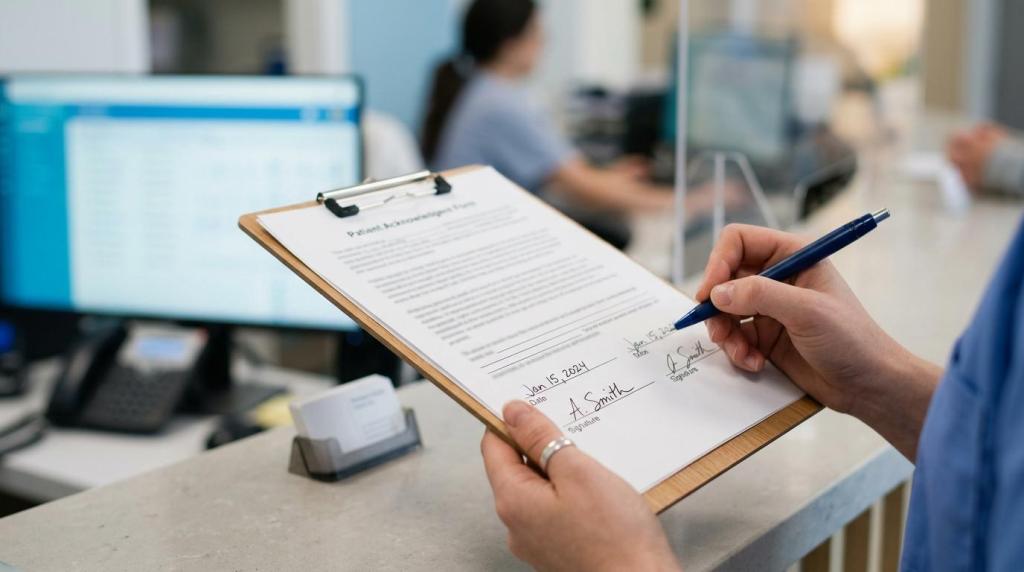
- Signed policy acknowledgment: Paper or electronic, stored where staff can retrieve it quickly
- Scheduling record: Appointment type, length, provider, and booking date
- Reminder log: Call, text, email, or portal message with time stamps when available
- Staff note: Who marked the visit as missed and when
- Waiver note: Why the fee was reduced or removed, with manager review if required
Communication deserves the same level of structure. Patients should know the cancellation window, the fee amount, how exceptions are reviewed, and whether future appointments may require a deposit after repeated no-shows. Short reminder language helps too. A reminder that repeats the cancellation window can reduce later arguments.
How to build a dental no-show charge policy that staff can actually use
The strongest policies are easy to explain at the front desk and easy to post in the billing system. If staff need to interpret vague language each time a patient misses a visit, the policy will drift. One coordinator may waive everything, another may charge everyone, and the office ends up with inconsistency that creates both financial loss and compliance exposure.
Start with appointment categories. A 15-minute follow-up, a 60-minute hygiene visit, and a reserved treatment block do not carry the same operational cost. Some offices use one flat fee for simplicity. Others set different fees by visit type. Either model can work if it is disclosed clearly and applied consistently.
Many practices also do better with a progressive approach instead of a single hard line. A first missed visit may trigger education and a warning. A second may trigger the fee. A third may require a deposit or same-day scheduling only. That structure often feels more reasonable to patients and gives staff a clear script.
A practical rollout usually includes four steps:
- Review payer and contract limits before the fee goes live.
- Update the financial policy and intake forms so the rule is disclosed clearly.
- Train front-desk and billing staff on posting, waiving, and documenting the charge.
- Audit the first 60 to 90 days to check consistency, complaints, and collection rates.
This is also where billing support can help. Whether the work is handled in-house or through a dental billing partner, the team posting charges should know that missed appointment fees are generally non-claim items, should be separated from insured treatment, and should be tracked for waiver patterns and repeat offenders.
Operational checks before posting a no-show fee
Before the practice adds a missed appointment charge to any patient ledger, staff should be able to answer a few basic questions. Was the patient told about the policy? Was the reminder sent to the right number or email? Is the fee allowed under the patient’s payer rules? Was there a documented reason to waive it?
If those answers are not easy to find, the policy needs work before it needs more enforcement.
The most reliable dental no-show charge policy is one that supports revenue, respects payer limits, and gives staff a repeatable workflow. That kind of policy usually brings better results than a high fee posted inconsistently after the fact.